The everday work of many academic librarians who deal with Open Access – and particularly those who deal with Green Open Access – is many times characterised by a myriad of small bits of information that is not sensitive, but that it is not public information findable in the Internet either.
It deals with practical matters like – and this is specially relevant for universities of applied sciences and of teacher education – informal agreements with small publishers and practice-oriented journals.
To clarify the secondary publication rights in all these cases – that is, to make Green Open Access a reality – means thus to collect, curate and update notes with information about who to contact where and ask for permissions or to note how to reach best authors to motivate them to ask for copies of their texts
Currently, this work, that costs many hours throughout the year, is almost exclusively based on personal experience, peer-to-peer informal transmission of knowledge and personal networks throughout the library ecosystem of a country.
The result is clear: Most institutions cannot exploit the full potential of Green Open Access and the smaller the library is – those with only one or two employees for Open Access – the bigger the challenge becomes.
Here is where GOAL-Hub comes in: In our project we have decided to tackle this challenge by exploring and testing the possibilities and limits of a bottom-up approach.
How can different academic libraries share information that is useful for librarians working with the clarification of secondary publication rights and do it independently from personal networks?
Our answer is by creating easy to use, basic shared infrastructure. We have called it « Internal Notes ».
The internal notes, build on DSpace using the architechture of the GOAL-database, are:
- Password-protected: Only seelcted members with an account can access the content and work with it.
- Easy to use: We have identified the minimal requirements that each institution has when it comes to collecting and curating the own information and transformed it in fields.
- Regulated by binding agreements: As the information is not publicly available, we have a binding Code of Conduct regulating the use of information.
- Scalable: If our experiment works, it can be expanded by welcoming further institutions
- Collectively maintained: Each instituions does its bit according to the own possibilities, and all partner institutions benefit.
- Replicable by other institutions: Being built on DSpace, if two or more libraries want to come together, they can replicate our model and start their own bottom-up collaboration.
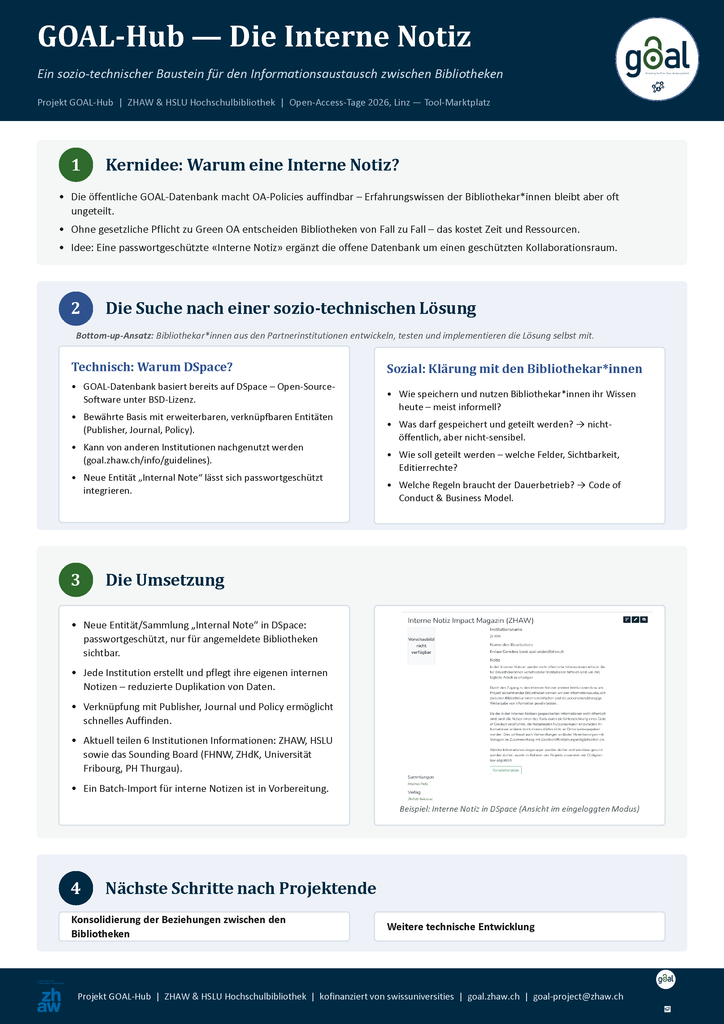
We are still working on this bottom-up experiment and collecting the experiences. An overview of our idea and an example of how such a note can look like is in the poster that illustrates this entry.